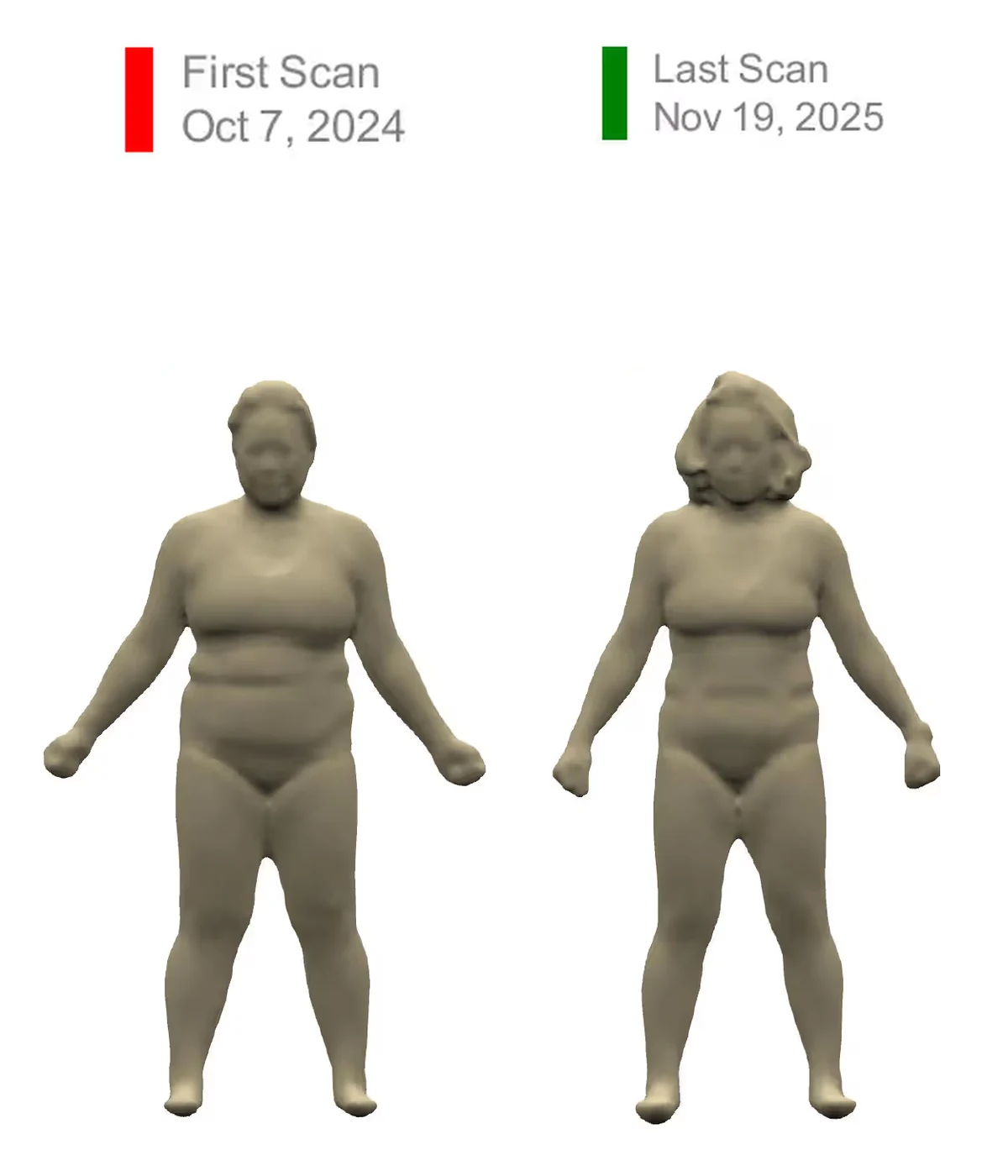
180 → 129 lbs · 27.6 inches off her torso · RDL 0 → 100 lbs

If this is you: In your 50s, on your feet all day, and something hurts most of the time. You've never lifted a weight. You know roughly what you should be eating, you just don't do it. You'd go to a gym if a friend went with you.
Marian is a teacher in her 50s. She's on her feet all day, and when she came to Kraken she was in pain for most of it: plantar fasciitis and a bad hip. She'd seen a few specialists and gotten different answers.
She had never done any resistance training. Her exercise was a 20 to 30 minute walk a couple of times a week. No food tracking, no structure, and a lot of snacking. She knew what she should be doing. She needed someone looking, not a lecture.
She came in with a friend, as a tandem pair, because neither of them was going to show up alone. Her goals were the usual list: get fit, get stronger, lose some weight, more energy. The real one was simpler. She wanted to stop hurting. And both of them said the same thing about the long run: they wanted to learn how to do this on their own.
The movement screen wasn't terrible, but the hip showed up on anything like a lunge. Low steps outside of work. Nothing wrong with what she knew about food, everything wrong with the routine around it.
That was the limiter: no routine. Not knowledge, not willpower. She needed a set time, a friend beside her, and a coach checking in. The hip was the limiter inside the gym, and that one wasn't going to be fixed in a week. Laura's job was to build the habit around it.
Write down what you eat. That was it.
No targets, no macros, no calorie number. Breakfast, lunch, dinner, snacks, and how hungry she was. Just knowing Laura would read it was enough to cut the snacking on its own.
Next step, months later: build every meal around a protein source. Still no counting. Around month four, when she was ready, they started tracking macros properly. And a real fat loss phase, with an actual deficit, didn't start until September, a full year after she joined.
That was on purpose. Laura kept offering the next step and never forced it. A year of building the skills meant that when the deficit finally came, it felt easy.
Not the food. Marian was the "tell me what to do and I'll do it" kind of client.
The hard part was the hip and back. Some weeks were good, some weren't. Deadlifts were off the table for months, so Laura swapped in hamstring exercises that got her stronger without loading the hip. The specialists didn't agree with each other, so Laura couldn't build around one diagnosis. She worked around the uncertainty instead. The pain also wrecked her sleep, and bad sleep made for flat workouts.
The other hurdle was courage. Tracking macros felt like a big step. So did agreeing to a deficit. Laura waited. One day the two of them walked in and said: we're ready, next week we start.
When the pain settled. Once she wasn't hurting all the time she slept, and once she slept she could train properly and think about goals instead of just getting through a session. Deadlifts and RDLs came back in.
Then the fat loss phase: September to November, maintenance through December so she could enjoy the holidays, and she came back after the break asking to do it again. Her words: "Why didn't I do this sooner?"
Laura sneaks the weight on, because Marian rates every set "it was good." "Did you realize you just did 100 pounds?" "Oh, I didn't know."
Laura: "They come in so excited to just chit chat. They lift heavy and they're like, how was your weekend? They're fun."
If something hurts and you've never lifted, the gym probably feels like the last place for you. It doesn't have to be. Your coach works around the pain, starts you on one small thing, and doesn't push the next step until you're ready. Bring a friend if that's what gets you through the door. That's what the free week is for.

5.0
408