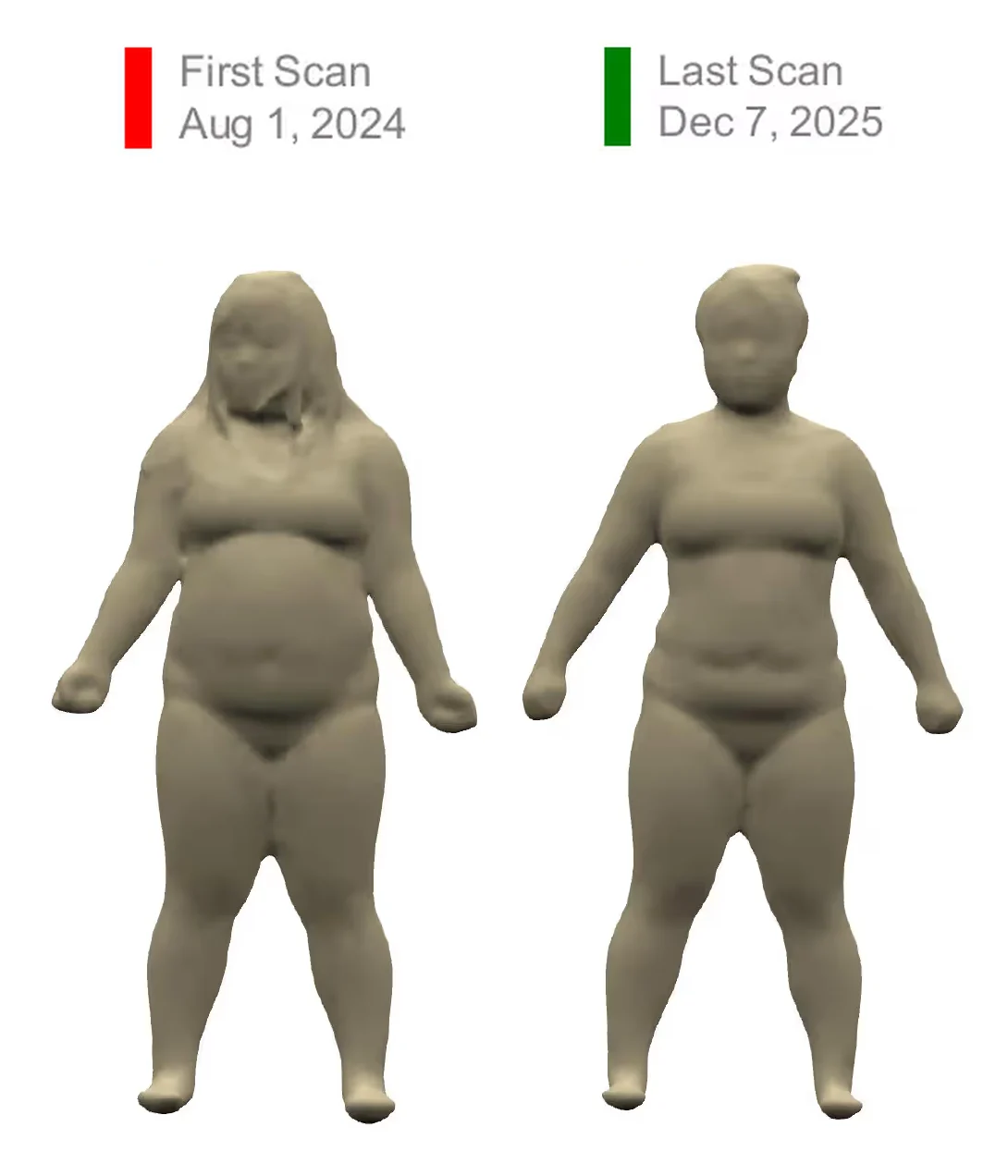
About 20 lbs down · 29 inches lost on the scan · Deadlift 205 lbs at 5'0"

If this is you: Office job, not much moving outside of it. You know how to track food. You do it well for days, then one blowout undoes the week and you spend the next few days making up for it. You've been told to "just get stronger" when what you wanted was to feel different in your body.
Linda works in an office. She's about five feet tall, likes baking, and by her own description did not enjoy moving. Most days she was under 2,000 to 3,000 steps. Some days, close to none. A night owl too, so mornings were not her friend.
She came to Gabby from her previous coach with a clear complaint. Her weight had been creeping up, around 170 lbs at her highest, and the training had been pushing strength when what she actually wanted was fat loss and a full-body change. Gabby listened and changed the approach.
Underneath the numbers was the real pattern, one Linda has talked about openly herself: eat well all week, then a big blowout, then punish herself for it. Almost every week or two. She was already tracking macros, and on the days she stuck to them she was perfect. The blowouts erased the rest.
The assessment showed what a desk and not much else usually leaves behind: a few small imbalances, low steps, short nights. But Gabby's first priority wasn't training or steps. It was Linda's relationship with food.
Her calories were set too high for a real deficit, so even a "good" week wasn't moving much. And the blowouts weren't a knowledge problem. Linda knew exactly what to do. A stricter plan wasn't going to fix that, and neither was shame. So Gabby kept the tracking method Linda already found easy and changed everything around it.
Gabby dropped Linda's calories significantly for a short fat loss phase, then gave carbs back week by week as a reward for consistency. Stick to the plan this week, get a bit more next week. That gave Linda a finish line she could see, and a reason to hang on through the harder middle weeks.
Steps came next, kept deliberately small. Not 10,000. A goal of 5,000, then 7,000. She takes transit, so she'd bus to the gym and walk home. Weeks she missed it, she'd bike the seawall on the weekend instead.
Two things. The first was strength. Linda is naturally strong, and that matters to her, so watching her lifts dip during the deficit was tough. Gabby had been upfront that it would happen, and that it would come back.
The second was the recovery phase. After the first fat loss block they moved to maintenance on purpose, and the scale ticked up after months of dropping. Gabby's job in those weeks was clarifying and reassuring, not lecturing. Linda kept tracking through all of it. Gabby: "Even if she had a day where she ate more calories, she tracked it. And I respect that."
And when a blowout did happen, there was no weigh-in the next day. They'd come in, train hard, ask what triggered it, and get back to routine.
Half a dark chocolate bar. Linda's cravings tended to be for fats, and she was low on them. So instead of fighting the urge, Gabby suggested she have half a bar when it hit, and tell herself that was enough. She tried it. Her words to Gabby: "I didn't binge more." Over her macros for the day, yes. But she stopped. For someone who had spent years in the all-or-nothing loop, that was the first proof she could have a craving and not lose the week to it.
Her strength came back too. "My strength is back. I didn't lose it."
Gabby: "She's a joy. Every single time I see her, she brings a smile to my face. Whether she's got enough sleep, whether she's had lots of stress in a day, she's going to give 100% to her training."
If you already know how to eat well and the problem is the blowout that erases it, a stricter plan won't help. Kraken's coaches start with the pattern, not the willpower. Sometimes the fix is a short, structured fat loss phase with a finish line. Sometimes it's permission to have the chocolate. That's what the free week is for.

5.0
408