
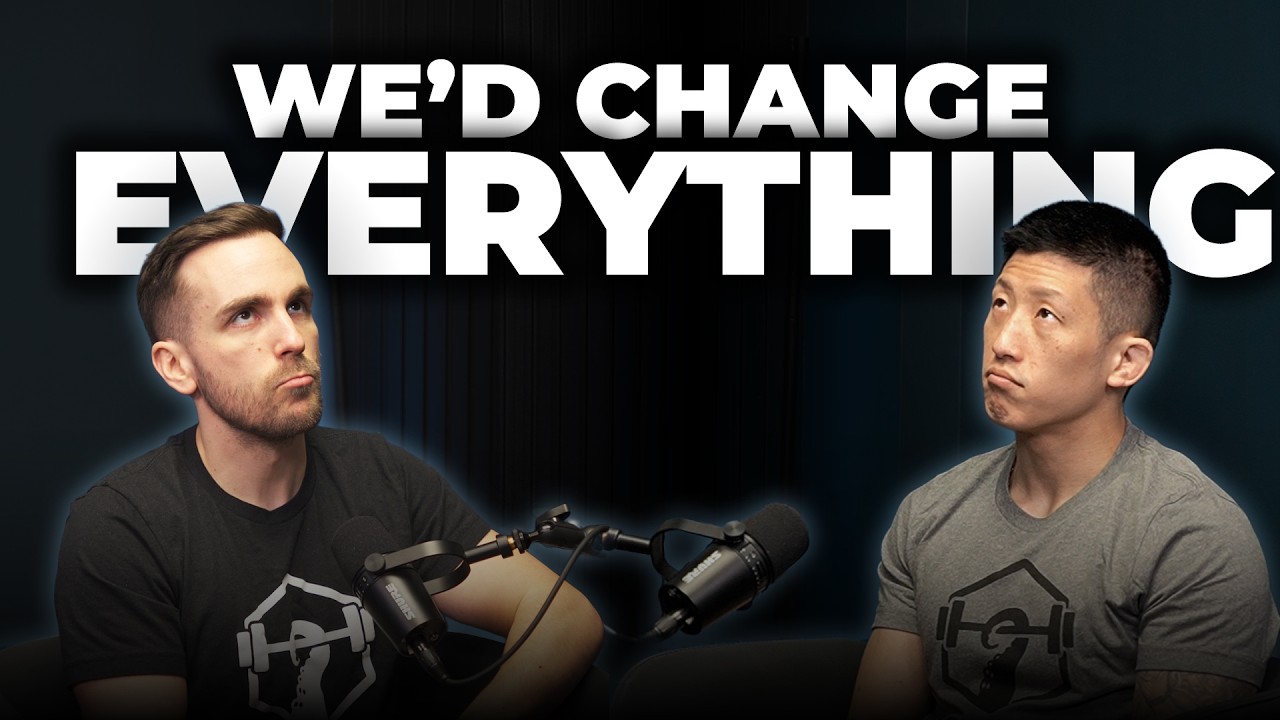
Starting at the gym for the first time is genuinely overwhelming. Hundreds of machines, unwritten rules, people who look like they know exactly what they’re doing – and you have no idea where to begin. In Episode 21 of the Kraken Power Podcast, Josko and Brandon asked themselves a simple question: if they had to start over from scratch, what would they actually do? Here’s the honest answer, from two coaches at Kraken Fitness in North Burnaby with over 10 years in the industry each.
Listen and Watch
Watch this episode on YouTube:
Listen on Spotify:
Start With a Personal Trainer (Even Just Three Sessions)
The first thing Josko would do if he started over is get a personal trainer. He knows how that sounds coming from someone who owns a gym. He says it anyway, because it’s true.
The point of a trainer at the beginning isn’t to get a perfect program. It’s to close the knowledge gap fast enough that the gym stops feeling foreign. Where to put your elbows on the lat pulldown. How to set the seat on the leg press. What weight to start with. Three sessions with even a mediocre trainer at a community center – 60 to 70 dollars a session – is enough to get those basics covered and make the gym feel like somewhere you can actually navigate on your own.
Personal training is expensive. That’s a real thing. But you don’t need months of it to get started. Three sessions, two times a week for the first month if budget allows, or just three standalone sessions if that’s all you can swing. The goal is a gym chaperone who walks you through the equipment and gets your foot in the door. Once that barrier is gone, everything else gets easier.
There’s also the safety angle. People are afraid of hurting themselves at the gym – and that fear is not irrational. You can get hurt in the gym. Josko has, doing exercises he knows well. The risk never goes to zero. But a trainer showing you basic movement patterns and how to use equipment correctly lowers that risk significantly at the stage when it’s highest.
There’s Nothing Wrong With Machines
The fitness internet has decided that machines are for people who don’t know what they’re doing, and free weights are for serious lifters. That take is wrong, and it stops a lot of beginners from getting started.
Machines were designed to reduce injury risk while still creating the stress and adaptation the body needs to get stronger. For someone brand new to the gym, that’s exactly what you want. A seated leg press won’t crush you. A chest press machine won’t tip over. The movement is guided, the weight is controlled, and you can learn what it feels like to push hard without worrying about form breaking down in dangerous ways.
Your body doesn’t know if the stress came from a barbell or a machine. It just knows stress happened and it needs to adapt. That’s the whole mechanism. A machine-only workout builds muscle, builds strength, builds the movement patterns, and builds the habit of showing up. None of that is lesser because it happened on equipment with a seat and a guided track.
Josko’s take on the free weights vs machines debate for beginners: stop listening to people on Reddit and do what you’re comfortable with. Barbell squats and deadlifts can come later when you have a feel for your body and how it moves. Starting on machines is not a shortcut. It’s just smart.
The Simplest Beginner Program That Actually Works
If Josko were writing a beginner program from scratch, it would look like this: seated leg press, leg curl or leg extension, chest press machine, lat pulldown, seated row. Five exercises. Three sets of each. Eight to twelve reps per set.
That’s it. No splits. No push-pull-legs. No A-day and B-day. Just that same workout two or three times per week with a rest day between sessions.
The reasoning is straightforward. At the beginning, the goal isn’t optimization – it’s habit formation. Showing up consistently to do the same simple thing builds the pattern. The workout itself is almost secondary. Once you’ve been going for a few weeks and the basic movements feel familiar, you can start adding exercises, experimenting with new things, and building out from there.
One thing Josko flags that a lot of beginners miss: at the start, just learn the movements. Don’t grind to failure on day one. As you get more comfortable, start pushing harder, getting closer to your limit on each set. The progressive challenge is what drives adaptation over time. But on week one, just moving the body and getting used to the equipment is enough.
Soreness is also worth mentioning. People follow a workout they found online, come in absolutely destroyed after one session, and never come back. A simple five-exercise program done at a sensible intensity won’t do that. You’ll feel it, but you’ll be able to walk the next day.
Gym Etiquette: What Nobody Tells You
The gym has its own unwritten rules. Nobody hands you a guide at the door, which means most beginners learn them by accidentally breaking them. Here are the main ones.
The phone rule is the biggest one. If you’re sitting on a machine scrolling between sets, people are waiting. Rest times should be around 60 to 90 seconds for most beginner exercises – not five minutes. If you need to check something, step off the equipment. The gym is a shared space, and the equipment is a shared resource.
Working in with someone is totally normal and acceptable. If someone is using a machine you need, you can ask to work in – take turns between their sets. The one exception is when swapping out handles or attachments would take too long or disrupt their setup. In that case, just let them know you want the machine next and you’ll wait. That alone is usually enough to move things along.
Clean up after yourself. Return weights to the rack. Don’t leave dumbbells scattered around your area. Wipe equipment when the gym provides wipes. None of this is complicated – it’s just being aware of the space you’re taking up and the people sharing it with you.
And if someone gives you unsolicited form corrections? That’s on them, not you. Josko himself never approaches strangers in the gym to correct their form unless they’re about to get seriously hurt. The people who do it unprompted are the exception, not the rule.
Nobody Is Watching You (Really)
Josko works out at a commercial gym, not at Kraken. He’s been coaching for 12 years and owns a gym. And he genuinely does not look at what other people are doing when he trains.
This is the reality of the gym. Everyone there is in their own head, focused on their own workout, managing their own fatigue. The person on the treadmill next to you is not evaluating your form. The guy on the squat rack is not watching you figure out the cable machine. They’re thinking about their next set.
The fear of judgment is real and completely understandable. But it’s mostly not matching what’s actually happening in the room. The people who are genuinely judging strangers at the gym are the outliers – and they’re the ones with the problem, not you.
If you’re brand new, rounds, your back, fumbling with the adjustment on a cable machine, or doing something that looks a little uncertain – that’s just starting out. Nobody who’s been training for any length of time looks down on that. Most of them remember exactly what it felt like.
Stop Overcomplicating It
The last thing that stops people from getting started – and keeps stopping them after they start – is information overload. Optimal rep ranges. Macros. Split programming. Periodization. Supplement stacks. All of it starts piling up before a single workout has happened.
Here’s the actual truth for a beginner: anything is better than nothing. When you’re new to training, your body has enormous headroom to respond to almost any stimulus. You don’t need the optimal program. You need a program you’ll actually do. Showing up twice a week and doing five simple exercises consistently will produce real results. A theoretically perfect program that’s too complicated to follow consistently will not.
Use AI if you want help building a simple program. Give it some context about what equipment you have, what you’ve learned, and what your goal is. It can put together something workable. But keep it simple. Five exercises, three sets, two or three days a week. Build the habit first. Optimize later.
Josko and Brandon close the episode with something worth repeating: the gym is a lot less complicated than the internet makes it. Go in, do what you can, get a trainer if you’re able to, and keep coming back. That’s the whole thing.
FAQ
Do I need a personal trainer to start at the gym?
You don’t need one, but even just three sessions makes a real difference. A trainer removes the knowledge gap fast – they show you how to use equipment, what weight to start with, and how to move safely. That confidence carries you a long way once you’re on your own.
Are machines okay for beginners or should I use free weights?
Machines are completely fine – and often smarter for beginners. They guide your movement, reduce injury risk, and still build muscle and strength effectively. Your body responds to stress regardless of whether it comes from a machine or a barbell. Start where you’re comfortable.
How many days a week should a beginner go to the gym?
Two to three times per week with a rest day between sessions is ideal. That’s enough stimulus to build the habit and see results without overdoing it and ending up too sore to come back. Consistency over the weeks matters far more than frequency within the week.
What’s a simple beginner workout program?
Seated leg press, leg curl or leg extension, chest press machine, lat pulldown, seated row. Five exercises, three sets each, eight to twelve reps. Same workout every session, two or three times per week. Add exercises as you get comfortable. Don’t split it up until you’ve built the habit.
What are the basic gym etiquette rules?
Don’t sit on equipment while on your phone. Rest between sets and then move on. Ask to work in if you want to share a machine. Return weights when you’re done. Be aware of the space you’re taking up. That covers most of it – the rest is just being considerate of the people around you.
Ready to Start?
If you’re in North Burnaby and you want to try the gym for the first time – or try it again after a gap – Kraken Fitness is built for exactly this. No judgment, real coaches, and a program that fits where you’re actually at right now.
Listen on Your Favorite Platform
Apple Podcasts – https://podcasts.apple.com/us/podcast/if-we-had-to-start-over-at-the-gym-after-10-years-ep-21/id1769000945?i=1000768743384
YouTube – https://youtu.be/AdWZsFduNX8
Spotify – https://open.spotify.com/episode/70amHycH5xsDVSXy4ih6LJ?si=f1b3ce08e9ee4280