
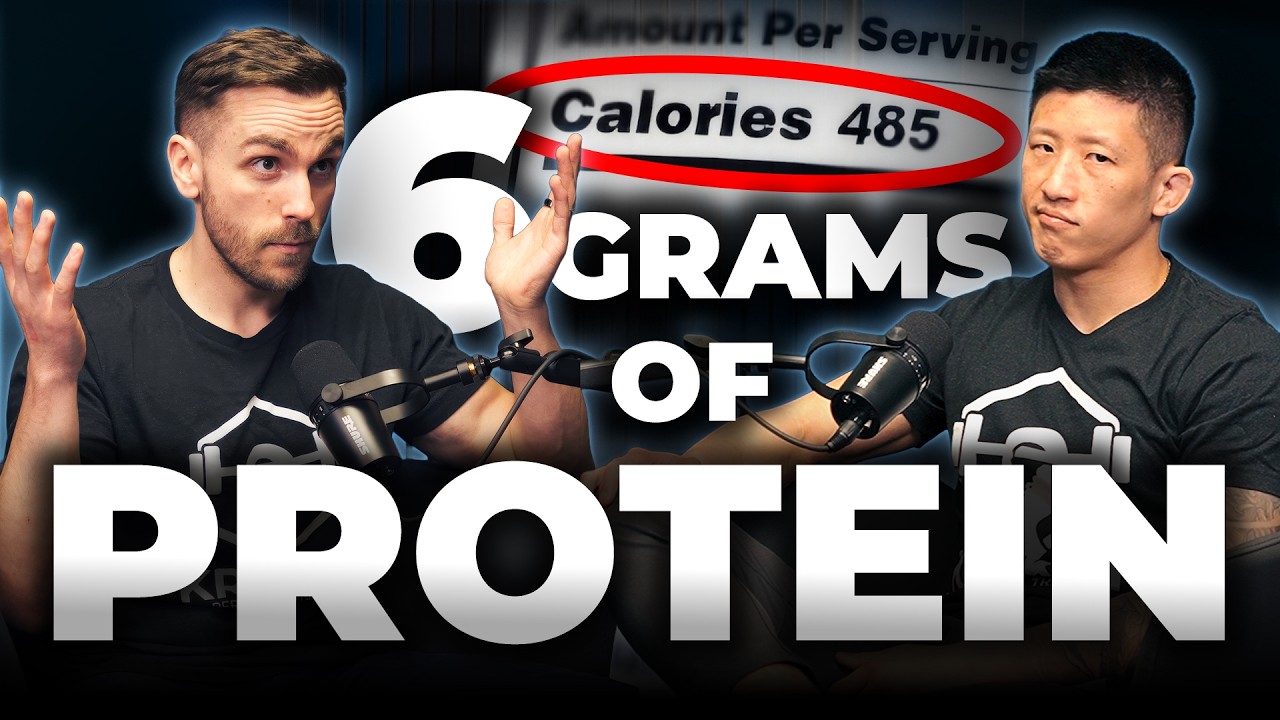
Walk through any grocery store in Burnaby right now and you’ll see it everywhere – cereals, granola bars, yogurts, bread, rice mixes – all stamped with “high protein” on the front. Most people grab them thinking they’re making a smart choice. They’re not. In Episode 24 of the Kraken Power Podcast, Josko and Brandon walked into the grocery store 5 minutes from the gym and grabbed the first products they could find with protein claims on the label. What they found on the back of those boxes tells you everything you need to know about what “high protein” actually means.
Why Everyone Is Talking About Protein
Protein is having a moment. And honestly, that’s not entirely wrong – most people probably aren’t getting enough of it. But somewhere along the way, the food industry figured out that “protein” is the magic word that makes people buy things. And now it’s everywhere.
McDonald’s has protein products. Burger King has protein products. Every cereal brand has a “high protein” version. The problem isn’t that protein is bad – it’s that the word has basically stopped meaning anything useful on a food label.
As Josko put it: “Everybody’s pushing protein and just protein and everything. And they’re just completely neglecting other nutrients.” When the whole conversation becomes protein at the expense of everything else – calories, food quality, bioavailability – you end up with people who think they’re eating well and can’t figure out why they’re not losing weight or building muscle.
The “high protein” trend has created a new kind of confusion. People scan labels for protein content, grab things that check that box, and end up with products that have more calories, worse ingredients, and less useful protein than just eating real food.
What “High Protein” on the Label Actually Means
There’s no strict regulation on what makes something “high protein” – and that matters a lot for what ends up on the shelf.
As far as Josko and Brandon can tell, companies compare their product to the average of similar products. A bread that has 5 grams of protein where most breads have 3 grams can technically call itself “high protein” or “double the protein.” It’s not lying, exactly. But it’s not meaningful either.
That two-gram difference isn’t going to change anything for you. And the marketing that comes with the “high protein” label usually means a price premium and, more often than not, extra calories.
There’s no consistent regulation for protein the way there is for fat, sugar, or sodium. Those nutrients have established thresholds for what “low” or “high” means on a label. Protein claims are essentially a free-for-all. Companies know that most people believe more protein is always better – so putting “high protein” on the front of a box is free marketing that nobody’s policing.
The result: a grocery store full of products where “high protein” tells you almost nothing about whether the food is actually good for you.
Bioavailability: Not All Protein Is Equal
The grams of protein on the label and the grams your body actually uses are not the same number.
Bioavailability is how much of a nutrient your body can actually absorb and put to work. Protein bioavailability varies a lot depending on the source. Meat, fish, dairy, and eggs are all highly bioavailable. Protein powder – particularly whey – is also highly bioavailable. Cereal protein? Not the same. Plant-based protein fillers? Not the same.
Collagen is one of the worst offenders. It’s getting added to everything right now – yogurt, coffee creamer, bars – because it’s cheap and shows up as protein grams on a label. But it doesn’t support muscle protein synthesis the way complete proteins do. It’s filler protein. If a product lists collagen as a primary protein source, those grams on the label aren’t doing what you think they are.
The process of stripping fat and sugar from dairy products to create high-protein versions is also worth understanding. That processing removes a lot of the nutrients that help your body actually use the protein. So even when a dairy product has been engineered to be high in protein, it may not be as useful to your body as just eating the less-processed version.
If you’re eating protein for muscle building, recovery, or body composition – collagen and plant-based fillers won’t get you there.
The Grocery Store Test: 3 “High Protein” Products
Before recording this episode, Brandon walked into the grocery store 5 minutes from Kraken’s gym in North Burnaby and grabbed the first products he saw with protein claims on the label. Here’s what the back of the box actually said.
Vector Cereal – 213 calories per serving, 5.6 grams of protein. For comparison, a can of tuna has around 20 grams of protein. Turkey slices from the deli will get you 20 grams for roughly 120 calories. Vector has about a quarter of that protein for nearly double the calories – and you’ll probably eat more than one serving.
Love Crunch Protein by Nature’s Path – The front label says 14 grams of protein. The back label says 9 grams. The difference? The 14 grams includes half a cup of skim milk – not just any milk, specifically zero-fat skim milk, chosen so it wouldn’t make the macros look even worse. The actual product alone is 9 grams of protein and 580 calories per cup. It also has 27 grams of fat and 66 grams of carbs, with sunflower oil listed near the top of the ingredients. The company name is Nature’s Path. The label says “protein.” Over a third of this product is essentially oil.
Nature Valley Protein Bar – 9 grams of protein, 180 calories, 37 grams per bar. This was actually the best of the three. The macros are more reasonable. But a 37-gram bar is gone in two bites. Nobody eats one of these as a meal. You’re eating two or three, and now you’ve added 360-540 calories for 18-27 grams of protein – which you could get from a couple of eggs and some chicken for way fewer calories.
The pattern: protein content is measured against unrealistically small serving sizes, calorie counts are high relative to protein, and each product is positioned as a health food when it’s mostly a calorie-dense snack with a protein sticker on it.
The Calorie Trade-Off Nobody Mentions
Here’s a realistic version of a day where someone is genuinely trying to eat more protein using “high protein” products.
Breakfast: high-protein cereal with milk – 15 grams of protein, around 500-600 calories. Lunch: high-protein yogurt with a turkey sandwich – maybe 20 more grams of protein, another 400-plus calories. Dinner: chicken breast with high-protein rice mix – 20 grams from the chicken, 6 from the rice, another 400-500 calories.
End of day: around 60 grams of protein. 2,500 to 3,000 calories.
For most people trying to lose weight, that calorie count is way too high. And a chunk of the protein they did get isn’t bioavailable anyway. They’ve worked hard to hit a protein number using a strategy that doesn’t actually work – and they’re wondering why the scale isn’t moving.
The alternative: swap those “high protein” products for actual protein sources and you can hit 100-plus grams of protein in the same calorie range. A can of tuna, some Greek yogurt, a piece of fish, a few eggs. No clever marketing required.
What to Actually Eat for Protein
The straightforward answer: meat, dairy, eggs, and fish.
These sources are highly bioavailable, naturally high in protein relative to their calorie count, and they come with the vitamins, minerals, and nutrients your body needs to actually process what you’re eating. You don’t need to decode a label.
A can of tuna – 20 grams of protein, around 100 calories. A cup of Greek yogurt – 15-20 grams. Two eggs – 12 grams. A chicken breast – 25-35 grams depending on size. Turkey slices from the deli – 15-20 grams for around 100 calories.
If you want to add protein powder, whey is a solid option. It’s highly bioavailable and easy to mix into oats, smoothies, or just with milk. Overnight oats with a scoop of protein powder can pack 40-50 grams of protein in a breakfast that actually keeps you full – and it ends up around the same calories as that Vector cereal with milk.
The rule Josko and Brandon use: eat things that are made of protein, not things that have had protein added to them. An egg is made of protein. A cereal with added soy protein isolate has had protein added to it. One of those is going to do a lot more for you than the other.
FAQ
Are “high protein” food labels regulated in Canada?
There’s no strict regulatory threshold for what makes a food “high protein” in Canada. Companies can use comparative claims – like “double the protein of regular bread” – without meeting a defined standard. Fat, sodium, and sugar have regulated claim thresholds; protein does not. Always flip the box and check the actual grams and calories per serving.
Is plant-based protein as effective as animal protein?
Plant-based proteins are generally less bioavailable than animal proteins. They often lack one or more essential amino acids, and your body absorbs and uses less of the total protein content. To get the same muscle-building effect as animal protein, you typically need to eat significantly more of it.
Is collagen a good protein source for building muscle?
Collagen is not a useful protein for muscle building. It’s missing essential amino acids and has poor bioavailability for muscle protein synthesis. It gets used as cheap filler in supplements and food products. If a product lists collagen as a primary protein source, those grams on the label aren’t building muscle.
What’s the easiest way to hit your daily protein without tracking everything?
Include a whole food protein source at every meal – meat, eggs, dairy, or fish. A palm-sized portion of protein per meal (roughly 20-30 grams) gets most people to an adequate daily intake. Greek yogurt or a protein shake as a snack fills gaps without adding many calories.
How much protein do most people actually need per day?
A solid starting point is 0.7 to 1 gram per pound of bodyweight. For a 160-pound person, that’s 112 to 160 grams per day. Most people relying on “high protein” packaged foods fall well short of this – and a portion of the protein they are getting isn’t fully usable by their body.
Ready to Start?
If you’ve been eating what feels like a high-protein diet and still not seeing results, you’re not alone. A lot of people in Burnaby are stuck in exactly this trap – spending more on “health food” that isn’t doing what the label promises. Kraken’s coaches work with everyday people to build simple, realistic nutrition habits that actually work. No complicated tracking apps, no gimmicks – just a plan that fits your life.